What Is Genetic Testing? A Beginner's Guide
Confused about genetic testing? Here's a plain-language guide to what it actually is, how it works, and why it matters for your health.
So what is Genetic Testing, really?
That's a loaded question, so let's back up and start from square one. There's a lot of confusion and misinformation floating around out there about genetic testing, and I get it. Genetic test availability has exploded over the last decade, with tens of thousands of new tests registered both in the US and globally in recent years.
Let's clear some of that up.
Your genome is your operating manual
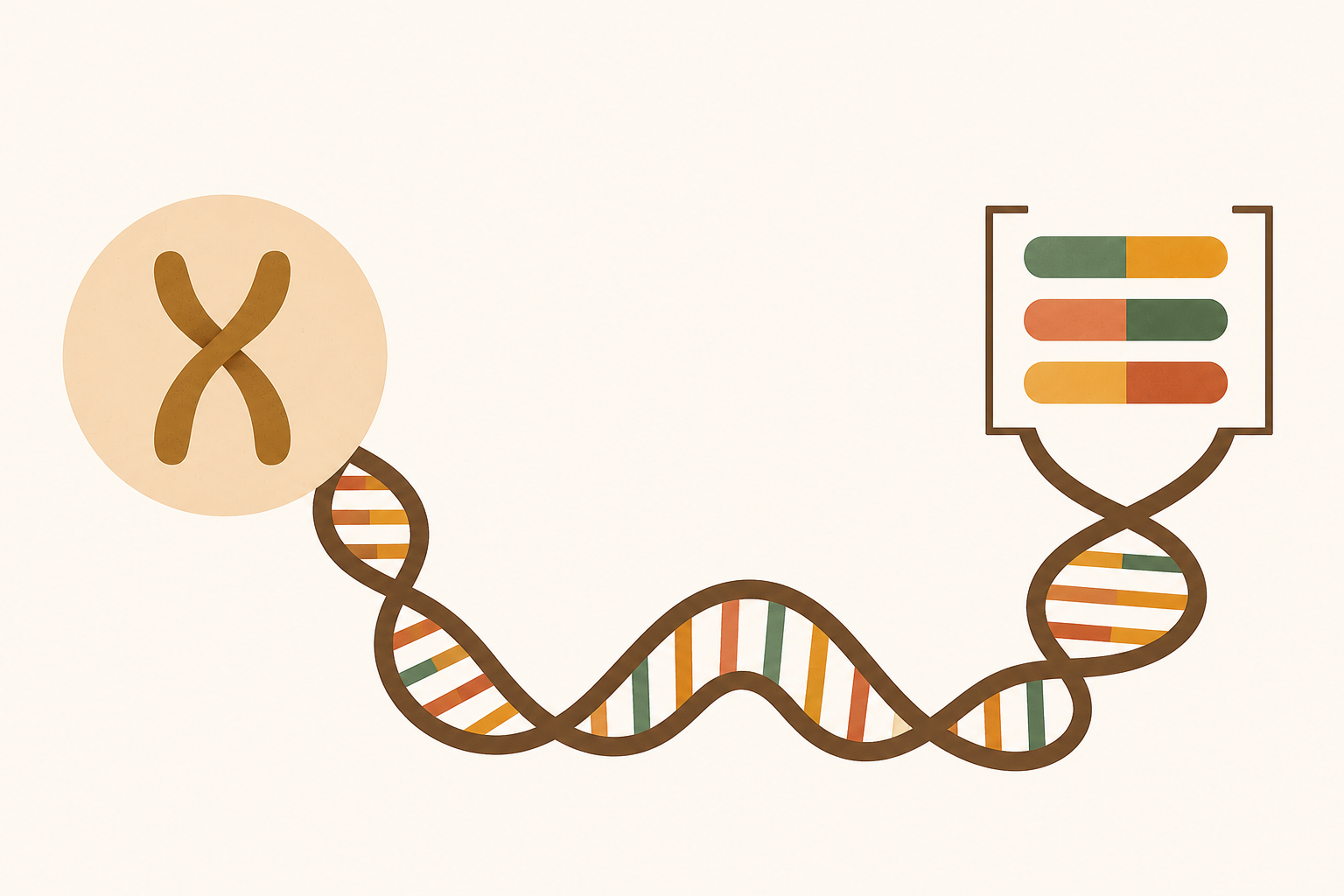
Think of your genome as the instruction manual your body runs on. It's made up of DNA, that familiar double helix, and when you untwist it, you find base pairs that read like a code. The order of that code is what tells your body how to grow, how to repair itself, and how to function day to day.
Here's the wild part: when researchers completed the Human Genome Project in 2003, they confirmed that the 3 billion base pairs making up human DNA are 99.9 percent identical from person to person. It's that tiny sliver, less than 1%, that makes you uniquely you. Small differences in that code are called SNPs (pronounced "snips"), and they're the reason two people can eat the same meal or do the same workout and get completely different results.
“Your genes aren’t your destiny. They’re information, and information is power.”
Genetic testing isn't one thing: know your options
There are a few different flavours of genetic testing, and they're not interchangeable:
Clinic-based testing is ordered and interpreted by a healthcare provider, often to diagnose or rule out a specific condition.
Direct-to-consumer testing is the spit-in-a-tube kind you order online. It can tell you about ancestry and basic traits, but the reports are often generic and leave you without much to actually do with the information.
Nutrigenomic testing, which is what I work with here in Calgary, looks specifically at how your genes interact with your diet, lifestyle, and environment. It's built to be actionable, not just interesting.
No, I'm not going to tell you your ancestry or whether your hair is destined to be curly. What I work with is 100% focused on the relationship between your genetics, your environment, your lifestyle, and your diet.
Why bother?
Because generic health advice is, well, generic. Genetic testing takes the guesswork out of questions like:
Why do I feel exhausted no matter how much I sleep?
Why can't I shake this brain fog?
Why does my body hold onto weight even when I'm "doing everything right"?
Why do my hormones feel like they're running the show?
Just because your genes show a predisposition toward something doesn't mean it's your destiny. It means you now have a map. And once you have a map, you can actually build a route around it, one that fits the body you actually have instead of the one some generic meal plan assumes you have.
Where do I come in?
I review your data. I connect the dots. I prioritize what actually matters instead of throwing every intervention at you at once. Getting your results back can feel like alphabet soup; honestly, it's pig latin for most people. My job is to translate the instruction manual into a language you can actually speak, and then help you make the small, meaningful changes that add up to lasting change.
Curious what your own genes have to say? Book a free 30-minute consult and let's talk about where to start.
Sources: National Human Genome Research Institute (genome.gov); Journal of Personalized Medicine, "Trends in Availability of Genetic Tests in the United States, 2012–2022"
